TraceLab — Building the Library That Teaches AI to Remember
An Autonomous Knowledge System that turns research into validated, searchable institutional memory.
Structured research platform that enforces data contracts through Pydantic validation and quality gates, enabling autonomous agents to generate reusable knowledge.
TL;DR
Challenge → Approach → Results
Challenge
Traditional research tools optimize for capture, not retrieval, creating 'knowledge graveyards' where valuable findings disappear after the initial study.
Approach
Inverting the schema from a human restriction to an agent contract, using Pydantic validation to force structured, auditable evidence generation.
Results
Validated institutional memory that compounds over time, with automated correction loops that ensure research meets quality standards before storage.
Outcomes
- PostgreSQL + Qdrant hybrid persistence
- Pydantic-enforced research contracts
- Automated evidence-to-chunk matching
- 6-layer hybrid search via PEDR
- Self-populating knowledge loops
Resources
The Problem: Knowledge Dies in Documents
Every organization does research. Market analysis. Competitive intelligence. Technical deep-dives. User studies. The work gets done, the findings get summarized, and then… they disappear into file systems, Notion databases, and SharePoint graveyards.
Six months later, someone else asks the same question. The cycle repeats.
This isn’t a storage problem—it’s a structure problem. Most research tools optimize for capture, not for retrieval. They make it easy to dump information in, but nearly impossible to get the right information out when you need it.
When AI agents entered the picture, this problem became acute. An autonomous research agent can generate findings at scale, but if those findings can’t be validated, stored systematically, and retrieved intelligently, you’ve just automated the creation of more knowledge debt.
The Insight: Schemas Aren’t Constraints—They’re Contracts
The conventional wisdom is that rigid schemas are the enemy of flexibility. But after 20 years building data platforms and design systems, I’ve learned the opposite is true: well-designed structure creates freedom.
The breakthrough for TraceLab came from inverting the typical approach:
- Instead of building schemas that restrict what humans can enter…
- Build schemas that define what AI agents must produce.
This turns validation from a bottleneck into a quality gate. An agent’s output either meets the contract or it doesn’t. If it doesn’t, the system can trigger a correction loop—not a human review cycle.
The restrictive schema becomes the structured output target. And suddenly, agent-generated research becomes automatically validated, stored, and searchable.
The Architecture: Three Services, One Knowledge Loop
TraceLab is the center of a three-part system we call the Autonomous Knowledge System. Each component has a clear role:
- DeepSearch (The Researcher): An autonomous agent that takes a mission, searches the public web, synthesizes findings, and—critically—checks existing knowledge first.
- TraceLab (The Library): The validation and storage layer. Every piece of research must pass through quality gates before it’s persisted. This is where the Pydantic models define what valid research looks like.
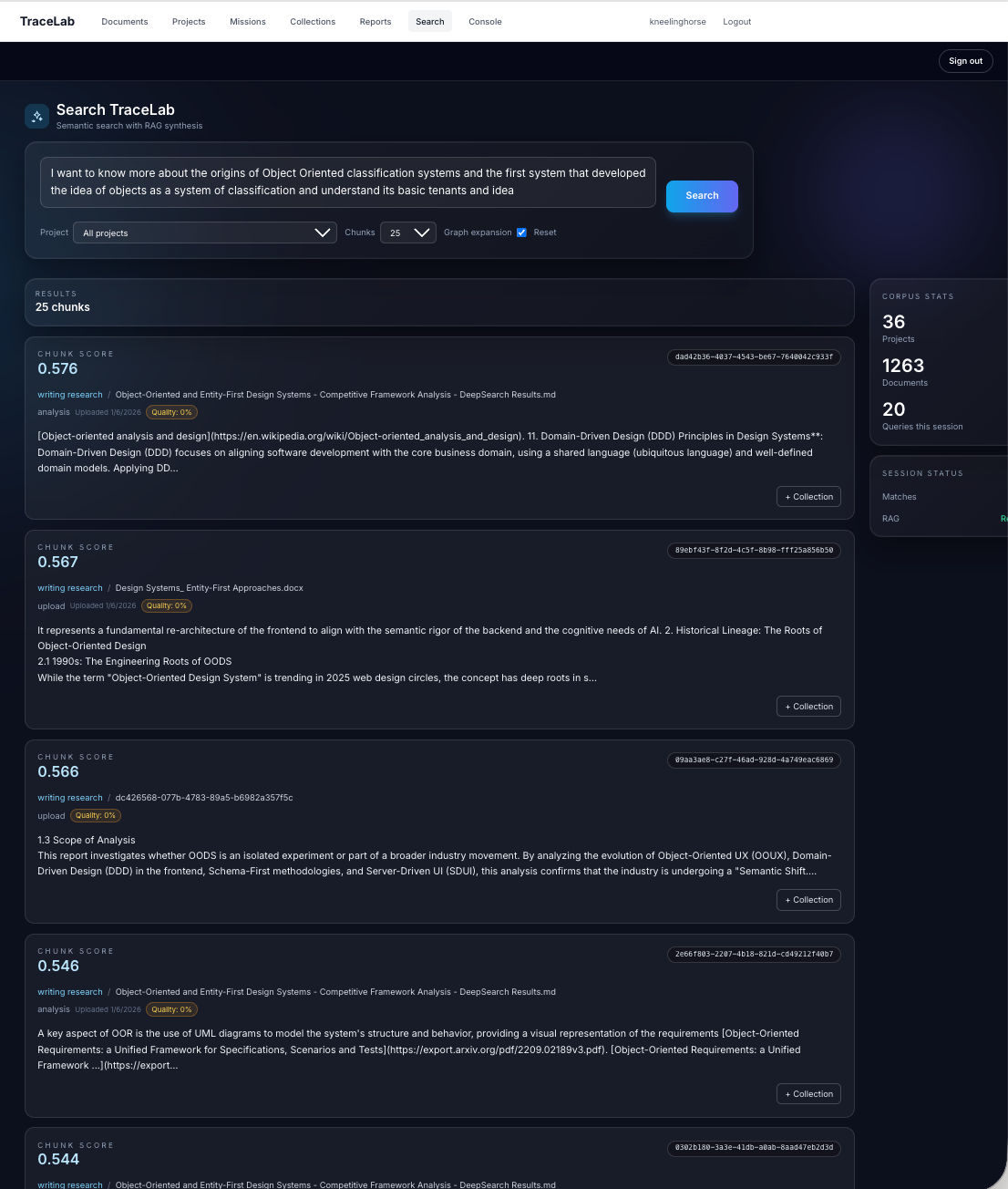
- PEDR (Protocol-Enhanced Deep Research): The search interface. A multi-layer hybrid search that understands not just keywords but relationships, lineage, and context.
Building Middle-Out
We didn’t start with the agent or the search interface. We started with TraceLab—the storage and validation layer. Why? Because the middle layer defines the contract between everything else.
If you build the validation layer first, you create guardrails that force everything else to be well-structured. It’s analogous to how APIs are designed in mature systems: define the interface contract first, then build implementations on both sides.
Current Capabilities
- TraceLab Core: PostgreSQL schema for projects, documents, insights, and missions.
- Vector Intelligence: Qdrant vector store for semantic chunking and RAG.
- Quality Gates: Pydantic validation layer that blocks unvalidated research.
- RAG API: High-performance endpoints for ingestion and retrieval.
Quality Gates: Validation as Feature
The Pydantic models aren’t just data classes—they encode research quality standards. If an agent submits an insight with unresolved contradictions, the system returns an error. The agent must resolve them before the knowledge enters the system.
This creates a correction loop: the agent’s failure isn’t a bug—it’s a signal to do more work.
Why This Matters
As agents become more capable, the bottleneck shifts from generation to validation. TraceLab provides the infrastructure that lets you trust agent output. Human review becomes a spot-check, not a requirement for every piece of content. Lineage tracking means you can answer “where did this claim come from?”—a requirement for high-stakes decision-making.
The Virtuous Loop
When all three components are connected, the knowledge base becomes self-populating. Each research mission makes the next one faster. Institutional memory compounds rather than decays.
Technical Details
- Stack: Python + FastAPI, PostgreSQL, Qdrant, Pydantic, LangChain.
- Principles: API-first design, every entity has lineage, validation at the boundary, hybrid search.